


Showing posts with label KHMERNEWS. Show all posts
Showing posts with label KHMERNEWS. Show all posts

Letters over the weekend from Prime Minister Hun Sen to key UN officials may be an attempt to prevent Thailand from resorting to violence over the border issue near Preah Vihear temple, a local analyst said Monday.
On Sunday, Hun Sen wrote the heads of the UN Security Council and its General Assembly, claiming Thai Prime Minister Abhisit Vejjajiva had threatened to use military force to resolve the longstanding border issue.
Hun Sen was responding to Thai media reports that quoted Abhisit telling a pro-government rally that Thailand could walk away from a border agreement signed in 2000 and “use both democratic and military means” to settle a standoff.
“I think this is a sign of alarm to the United Nations Security Council to prevent the border dispute not going toward war and bloodshed,” Chheang Vannarith, the president of the Cambodian Institute for Cooperation and Peace, told VOA Khmer Monday.
“Cambodia is a small country” that needs multilateral support, “particularly the UN,” he said. “So these letters are diplomatic politics from Cambodia to put pressure on Thailand to not use illegal military force.”
Cambodia and Thailand remain at odds over a 4.6-kilometer stretch of land west of Preah Vihear temple, which was made a Unesco World Heritage site under Cambodian protection in 2008. Thousands of troops on each side are amassed on the border, where skirmishes since 2008 have left at least eight soldiers dead.
Both sides severed diplomatic ties last year after Cambodia hired ouster Thai premier Thaksin Shinawatra as an economic adviser to Hun Sen.
“I think the letters to the UN are a step toward peaceful resolution with UN intervention,” Cheang Sokha, director of the Working Group for Peace, said Monday. “The letters are a call for the help from the international community on the Cambodia-Thailand border problem and provide information to UN about the possibility of Thailand using military force to invade Cambodia.”
“I think the letters to the UN are a step toward peaceful resolution with UN intervention,” Cheang Sokha, director of the Working Group for Peace, said Monday. “The letters are a call for the help from the international community on the Cambodia-Thailand border problem and provide information to UN about the possibility of Thailand using military force to invade Cambodia.”
Hun Sen discussed the letters in a public speech on Monday, saying Cambodia would “fight against a warlike Thai invasion inside Cambodia” and “call an urgent [UN] meeting on the Cambodia-Thai border situation” if Thailand were to resort to military violence over the border.
The Bangkok Post reported Monday that Thai Foreign Ministry officials are preparing a response to the UN that claims, “Thailand had never changed its position, of wanting to cooperate with its neighbor and share common interests.”
The Thai / Cambodia Border Camps
1975 - 1999
Over the years there were many camps along the Thai / Cambodian border. There were 5 significant population movements that created new camps and sometimes destroyed old camps: Starting in 1975 with those fleeing the Khmer Rouge when they took power, followed in 1979 by those fleeing starvation and the advancing Vietnamese army, followed by those affected by the 1984/85 Vietnamese offensive along the Thai border, followed by those fleeing the 1997 coup by Hun Sen and finally followed by the remnants of the Khmer Rouge in 1998. The last border camp closed in 1999. | 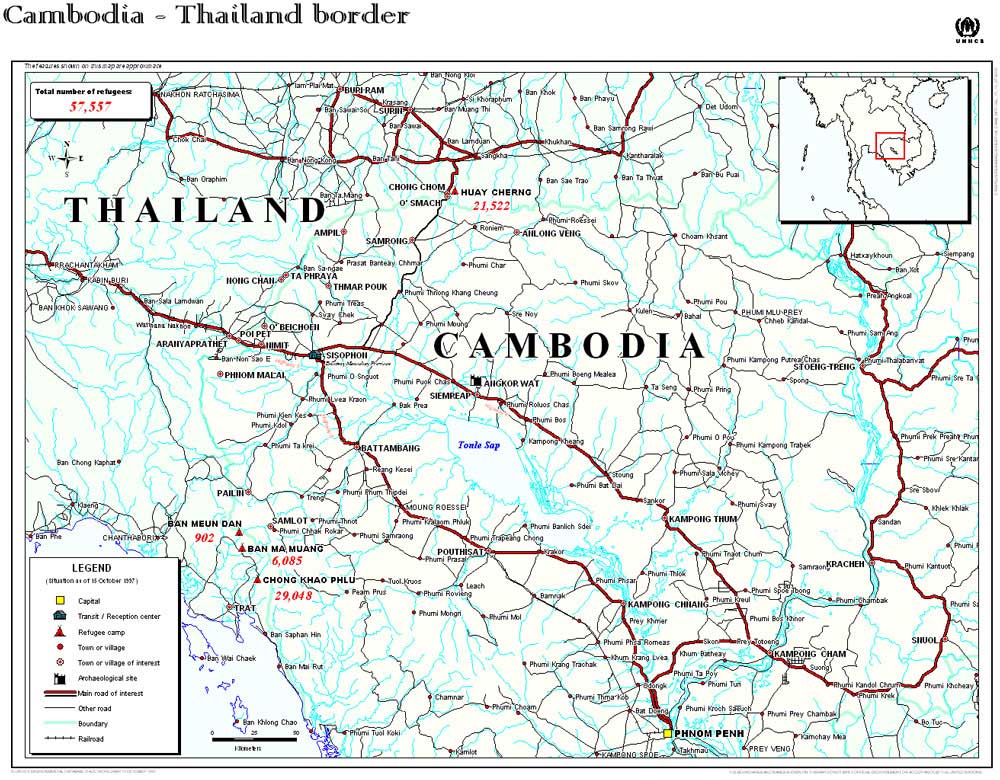 Thai / Cambodian Border 1997 |
 Children | 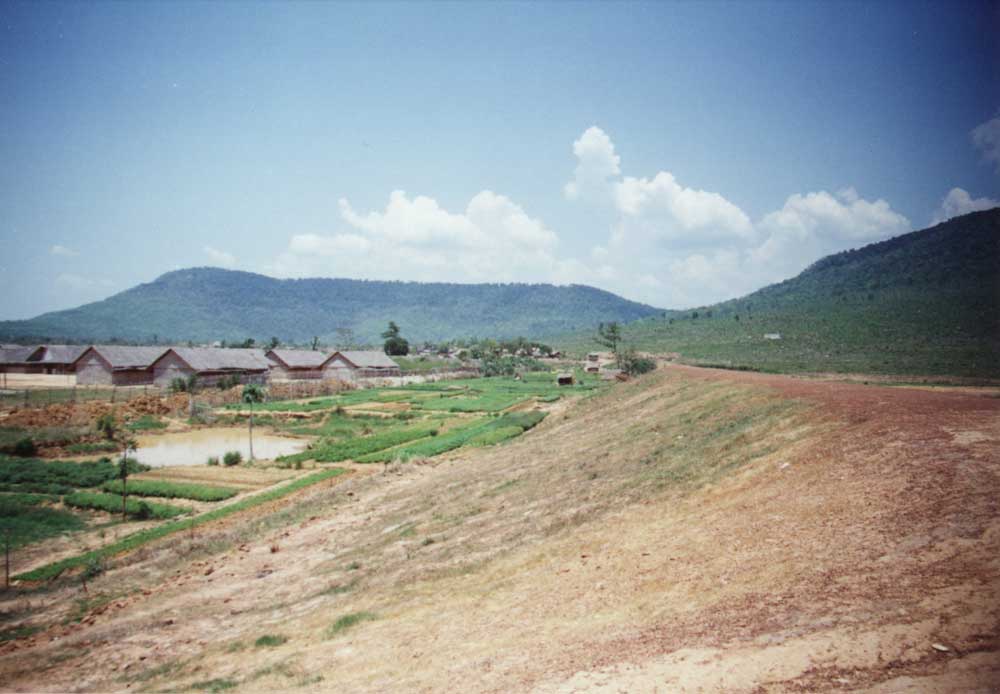 Site II |  Soldier Photo by Erez Yanuv |
Thai / Cambodian Border Camps 1975 - 1999 | |
| 007 | Early camp near Nong Samet, population went to Nong Samet. |
| Ang Sila | Circa 1983. Evacuation site for Nong Chan prior its incorporation into Site II (1986). Received residents of Nong Chan temporarily during offensives of 1983. |
| Ampil | Sub-camp of Site 2 and KPNLF military headquarters in Cambodia - Ban Sangae / Ban Sa Ngae. |
| Anlong Veng | KR camp / stronghold, opposite Sisaket province, Thailand. |
| Aranyaprathet camp 15 | Ban Thai Samart - opened Sept. 1976. |
| Ban Baranae | Circa 1984. FUNCINPEC camp, see Site B. |
| Ban Kaeng | See Sakeao |
| Ban Mamuang | September 1997 to March 1999, housed refugees from coup. (United Nations High Commissioner on Refugees (UNHCR), Vulnerable Groups Survey: Ban Mamuang and Khao Phlu Camps, Bangkok: UNHCR, 1998) |
| Ban Napho | Lao border camp - MOI. |
| Ban Nam Yao | Lao border camp - MOI. |
| Ban Sae Prai | 1998 camp in Phu Sing District, Sisaket. Refugees from Anlong Veng. Closed March 24, 1999. |
| Ban Sangae / Ban Sa Ngae | see Ampil |
| Ban Thad | UNHCR refugee camp for Vietnamese, adjacent to Site II. Closed in 1990. |
| Banthai Samath | Active in 1987 (opening and closing dates unknown). |
| Ban Vinai | Lao border camp - MOI. |
| Borai | UNBRO / KR displaced persons camp in Trat, Thailand opposite Pursat province in Cambodia. |
| Bung Beng / Klong Wah | KR Camp evacuated in 1985 to Site 8. |
| Camp 004 | Established in response to an attack on Non Samet camp in Jan. 1980 by Kmère Rouge. Near Mak Mun. |
| Camp 85 | KR camp inside Cambodia - see Phum Doeng. |
| Chakri | This was not so much a refugee camp as a ‘khum’ (hamlet) of scattered settlements hugging the Thai border. With a population of at least 10,000 people, it was made up in part by the former residents of the military camp known as "Khao Din" or "Site 8 North". |
| Chanmeh | Circa 1983. Evacuation site for Nong Chan prior its incorporation into Site II (1986). Received residents of Nong Chan temporarily during offensives of 1983. |
| Chiang Kham | Lao border camp - MOI. |
| Chong Bok | KR camp. |
| Chu Kaki | A meeting point for the Red Cross to receive war wounded in Odar Meanchey. The area around Chu Kaki has thousands of residents, many of whom formerly lived in the camp known as An Kbal Leov. |
| Dang Rek | Sub-camp of Site 2, established in mid-1983, incorporated into Site 2 in March 1985. |
| David | Circa 1984. FUNCINPEC camp, see Site B. |
| Green Hill | FUNCINPEC camp near to Site B but in Cambodia. |
| Huay Chan | UNBRO / Khmer Rouge displaced persons camp. Situated near the border of Sisaket province in Thailand and Preah Vihear in Cambodia. |
| Huay Cherng | FUNCINPEC camp - 1997 (UNHCR Map) |
| Kab Cherng | Lao border camp - MOI - also housed Khmer overflow from KID - opened October 1980, closed October 1981, reopened again in October 1983 to house refugees claiming Thai citizenship. |
| Kamput Holding Center | Processing center for immigration to U.S. - opened 1979, closed Dec. 1982. Originally a KR camp, converted to a processing centre, then closed. |
| Kap Choeng | Camp in Surin opened in Aug. 1980, ICRC surgical hospital. |
| Khao Din | KR Camp evacuated in 1985 to Site 8. |
| Khao-I-Dang | MOI / UNHCR Khmer refugee camp. Opened Nov. 21, 1979. |
| Khao Phlu | September 1997 to March 1999, housed refugees from coup. ARC provided medical care. 1998, approximately 12,000 Cambodian refugees. |
| Klong Wah / Bung Beng | KR Camp evacuated in 1985 to Site 8. |
| Lum Pi Ni | Transit camp near the international airport in Bangkok. Circa 1981. Some people were moved through this camp to Galang camp in Indonesia. |
| Mak Mun | Population went to Nong Samet camp. |
| Mairut | Camp / processing center (1980 - 81). Originally a KR camp for 2 years it was converted into a processing centre and the people moved to Khao I dang. It was located in Trat province 2 km from Mairut village, 40 min. north of Klong Yai. |
| Nam Yuen | see Nong Chan |
| Nam Yun | KR camp. |
| Na Trao | See O'Trao. |
| Nong Chan | Sub-camp of Site 2, incorporated into Site 2 in 1986. A KPNLF camp inside Cambodia. Also known as Nam Yuen. |
| Nong Pru | KR Camp evacuated in 1985 to Site 8. |
| Nong Samet | Sub-camp of Site 2 also known as Rithysen. Established in 1979 near Khao I Dang, incorporated into Site II after its destruction in December 1984. A KPNLF camp inside Cambodia / Red Hill. |
| NW 82 | Camp for Vietnamese land refugees opened at Nong Samet Dec. 1981. |
| NW-9 | Camp opened for Vietnamese who walked across Cambodia - April 1980 to July 1981. 4.5 miles from Nong Chan. |
| O'Bok | Sub-camp in Site II. |
| O'Smach | FUNCINPEC camp inside Cambodia, opposite Surin province, Thailand. |
| O’Sralau | KR Camp evacuated in 1985 to Site 8. |
| O'Trao | UNBRO / Khmer Rouge displaced persons camp. Situated near the border of Sisaket province in Thailand and Preah Vihear in Cambodia. |
| PARA | 1987? |
| Phanat Nikhom | Refugee processing center. |
| Phnom Malai | KR stronghold in Cambodia, near Aranyaprathet. |
| Phum Doeng | Known to the Thai as Nong Prue, this khum ( "hamlet") of scattered settlements is in northern Battambang Province due west of "Poipet Chas". It had a population of at least 1 0,000 people made up in part by the former residents of the KR military camp known as "Camp 85" or "Site 8 West". |
| Phum Tmey | See Site 8. |
| Plerng Chheh | Known to the Thai as Sop Tlee, this area may also be regarded as a ‘khum’ of scattered settlements in southern Battambang Province hugging the Thai border. |
| Red Hill | Formerly Nong Samet. |
| Rithysen | See Nong Samet. |
| Sakeo Holding Center Sakaeo I | Also known as Ban Kaeng. Early Khmer refugee camp, opened October 1979. Near to Sakeo (now the provincial capital), off the road from Aranyaprathet to Sakeo. According to eyewitness reports run by a KR commander by the name of Prak Lim. "I witness a few "repatriations" in those days, trucks of young KR fighters leaving the camp at about 11pm for the border. A lot of the camp inmates resisted these repatriations and their appeals to the UNHCR man there went unheeded." Closed in 1982, the residual population was transferred to Khao I Dang. |
| Sakaeo II | Opened July 1980, closed in 1984. |
| Site 1 | Evacuation center in the vicinity of Site II. |
| Site II / Site 2 | UNBRO / KPNLF displaced persons camp near Taphraya, Thailand. |
| Site 3 | Circa 1983. Evacuation site for Nong Chan prior its incorporation into Site II (1986). Received residents of Nong Chan temporarily during offensives of 1983. |
| Site 6 | Circa 1983. Evacuation site for Nong Chan prior its incorporation into Site II (1986). Received residents of Nong Chan temporarily during offensives of 1983. |
| Site 8 | UNBRO / KR displaced persons camp south of Aranyaprathet, Thailand. Opened early 1985. Also known as Phum Tmey. |
| Site 8 North | KR camp inside Cambodia, see Khao Din. |
| Site 8 West | KR camp inside Cambodia - see Phum Doeng. |
| Site A | ? |
| Site B | UNBRO / FUNCINPEC displaced persons camp 80Km from Surin, Thailand. Also known as Green Hill. Established June 1985. |
| Site E | See Sok Sann. |
| Site K | UNBRO / KR displaced persons camp in Trat, Thailand opposite Pursat province in Cambodia. |
| Sok San | UNBRO / KPNLF displaced persons camp in Trat, Thailand opposite Pursat province in Cambodia. Also known as Site E. |
| Tap Prik | KR Camp evacuated in 1985 to Site 8. |
| Tatum | A FUNCINPEC camp of a least 20,000 people situated in Siem Riep province approximately two hours walk from Site B camp. It was the home for ANS combatant personnel and their families. |
| Ta Luan | KR camp. |
| Ubon Royal Thai Air Force Base Processing Center | Setup in the spring of 1975 to relocate people fleeing the fall of the governments of both Cambodia and Vietnam it was probably the first processing center setup in Thailand. Closed date: unknown. The people arrived every way imaginable including trucks, helicopters, and on foot. Many of the people that had been evacuated from Saigon and Phnom Penh in Operation Eagle Pull (Cambodia) and Operation Frequent Wind (Vietnam) were eventually sent there. There were Vietnamese, Hmong, Cambodians some Mountainiards and Laotians. The camp had a conglomeration of buildings, aircraft hangars, tents and open air. Initially the U.S. State Department was in charge of the operation of the camp. Medical care was provided by Air Force corpsmen who treated the sick and injured. |
| Wat Ko | Circa 1979. In Wat Ko, in Aranyaprathet. This one of the camps from which people were taken and forcibly repatriated to Preah Vihear in June 1979. |
1989 Border Khmer Demographic Survey - includes camp descriptions and additional historical information.
Background
The later border camps with the exception of Khao I Dang were managed by UNBRO (United Nations Border Relief Operation - under UNDP) and supported by the NGOs that ran the infrastructure programs.
The border camps were not recognised as refugee camps, that is, the UNHCR did not manage them or have any official connection with them. Khao I Dang was the only UNHCR camp on the border, with its residents enjoying the rights due refugees, all of the other camps were "Displaced Persons" camps whose residents were not eligible for asylum, emigration, nutritional or health standards and rights due a refugee.
The displaced persons camps were formally under Thai control (JOC/SC), who in turn allowed the Cambodian resistance factions to control the civilian populations in each camp. These included the Royalist FUNCINPEC party, KPNLF - Khmer Peoples National Liberation Front and the Khmer Rouge or DK.
The displaced persons camps served the purposes of the Thais, China and the West. The Thais were trying to stop the flood of refugees and destabilize the Vietnam supported Phnom Penh government. The West also wanted to keep the pressure on both Vietnam and Cambodia and indirectly on the Soviet Union. China wanted to apply pressure on Vietnam. They accomplished this by supporting the resistance factions with arms, training and bases in Thailand. They legitimized their support by allowing the factions to herd Cambodian civilians into closed border camps in Thailand and claim them as supporters who needed humanitarian assistance.
Life in the Camps
According to Ogata (head of UNHCR) during a visit to the border in 1991, the Khmer were the "best cared for refugees in the world"; she added that this was a real disincentive for them to repatriate and that their services should be cut!
Life in the border camps was on the whole better than inside Cambodia - food, water, shelter, healthcare and education, all were consistent in provision and in most cases superior to what existed in Cambodia. But the population density and abnormal environment made for an unnatural and stressful existence. Many people came to use the camps as a backup during times of drought or fighting in Cambodia.
There was the dark side to the camps with all manner of exploitation and human rights violations ranging from conscription and forced population movements to extortion and physical abuse by Thai authorities. Add to this an abundance of war weapons and the potential for deadly violence multiplies. It was not unusual to hear of grenades and RPGs being used in personal disputes.
By 1992 the border camps were nothing short of Cambodian cities in Thailand, despite the efforts of the Thai government to prevent permanent settlements. One of the Thai rules was that there should be no permanent structures in the camps. They compromised by allowing concrete floors for our printing presses and large paper cutting machines, all other structures were made of bamboo and thatch. Some ingenious and well off Khmer built concrete bomb shelters to protect their families during periodic shelling or frequent bandit attacks on the camps.
Programs
After so many years the infrastructure was impressive, from the water and sanitation to ICRC's surgical hospital in Khao-I-Dang to the two functioning universities in Site II, there was little in Cambodia to compare.
Water -
provided and distributed directly by UNBRO
Sanitation and Site Maintenance -
CONCERN, IRC (KID)
Health care -
ARC, IRC, CRS, COERR, COR, CAMA, Handicapped International, UNBRO - pharmacy, surveillance, Psychiatric hospital - KID
Food -
provided and distributed directly by UNBRO
Each person on a family card received food ration (family cards were a constant source of counterfeiting and multiple registration). Those who worked were paid with an additional rice ration. Excess rice was sold to Thai traders who sold it back to the suppliers to UNBRO.
Education -
Primary education - coordinated by UNBRO, provided by Khmer, IRC (KID)
Secondary Education - COERR, IRC (KID)
Vocational Training - COERR, Dom Bosco, IRC
Teacher Training - IRC
University - COERR, KP
Printing - IRC, JRSC (KID only)
Computer training - IRC
There were 50,000 children in school using books printed in the camps, the literacy rate far exceeded that in Cambodia. There was a biweekly Khmer language newspaper.
Social programs -
Unaccompanied minors - COERR
AA - COERR - Site II
Prisoner rehab - COERR - Site II
Special Ed - IRC - Site II
Khmer Fine Arts - IRC - KID
TMC - Traditional Medicine Clinics - KID
Unaccompanied Minors - COERR, IRC
LMAP - Land Mine Awareness Program - IRC - all camps
Border Refugee Population | |||
| Year | Population | Year | Population |
| 1975 | 1987 | ||
| 1976 | 1988 | ||
| 1977 | 1989 | ||
| 1978 | 1990 | ||
| 1979 | 1991 | ||
| 1980 | 1992 | ||
| 1981 | 1993 | ||
| 1982 | 1994 | ||
| 1983 | 1995 | ||
| 1984 | 1996 | ||
| 1985 | 1997 | 57,557 (UNHCR Map) | |
| 1986 | 1998 | ||

Dear Readers,
Because several of our team members will be traveling to remote areas where Internet access is rather inexistent (read Cambodia’s remote countryside), news updates on KI-Media will be reduced between Saturday 07 August and Tuesday 10 August 2010. A few of us will be back after 10 August and we expect to update the news regularly again by 11 August (Phnom Penh time).
We apologize for this inconvenience and we hope to see you back on Wednesday 11 August 2010.
Thank you again for your constant support!
We apologize for this inconvenience and we hope to see you back on Wednesday 11 August 2010.
Thank you again for your constant support!
KI-Media team
 Click on text to read the letter.
By Khmerization
Cambodian Prime Minister Hun Sen has sought UN's help by writing a letter to the UN Security Council after Thai Prime Minister Abhisit Vejjajiva threatened to use force to settle the Preah Vihear dispute if diplomacy does not yield a satisfactory result for Thailand.
In an address to Thai protesters on 7th August, Mr. Abhisit was alleged to have said that Thailand is prepared to use force to take control over a plot of land surrounding the temple complex claimed by both Thailand and Cambodia. "About the land encroachment, we will cancel the MOU if the problem can't be settled. We will use both democratic and military means," Mr. Abhisit was quoted by The Nation newspaper as telling the protesters. The Cambodian Foreign Ministry swiftly issued a strong statement in response to Abhisit's threats.
In the letter, Mr. Hun Sen had drawn the attention of the UNSC to the fact that Preah Vihear temple issue had been settled once and for all by the Franco-Siamese Convention of 1904, the Franco-Siamese Treaty of 1907 and the verdict of the International Court of Justice (ICJ) of 1962 and the 1908 maps which were accepted by the then Siamese king.
Mr. Hun Sen's letter had also drawn the UNSC's attention to the verdict of the ICJ which stated that "...the Temple of Preah Vihear is situated in territory under the sovereignt of Cambodia;"
and that "Thailand is under an obligation to withdraw any military or police forces, or other guards or keepers, stationed by her at the Temple, or in its vicinity within Cambodian territory."
The letter accused Thailand of violating articles 2.3 and 2.4 of the UN Charter. The letter also stressed that Cambodia re-affirms its policy not to use force to settle any disputes, but said it reserves its "legitimate rights" to defend its "sovereignty and territorial integrity" in the face of aggression by Thailand.
Mr. Hun Sen had also requested the UNSC to widely circulate the letter to all members of the UNSC for information.
In an address to Thai protesters on 7th August, Mr. Abhisit was alleged to have said that Thailand is prepared to use force to take control over a plot of land surrounding the temple complex claimed by both Thailand and Cambodia. "About the land encroachment, we will cancel the MOU if the problem can't be settled. We will use both democratic and military means," Mr. Abhisit was quoted by The Nation newspaper as telling the protesters. The Cambodian Foreign Ministry swiftly issued a strong statement in response to Abhisit's threats.
In the letter, Mr. Hun Sen had drawn the attention of the UNSC to the fact that Preah Vihear temple issue had been settled once and for all by the Franco-Siamese Convention of 1904, the Franco-Siamese Treaty of 1907 and the verdict of the International Court of Justice (ICJ) of 1962 and the 1908 maps which were accepted by the then Siamese king.
Mr. Hun Sen's letter had also drawn the UNSC's attention to the verdict of the ICJ which stated that "...the Temple of Preah Vihear is situated in territory under the sovereignt of Cambodia;"
and that "Thailand is under an obligation to withdraw any military or police forces, or other guards or keepers, stationed by her at the Temple, or in its vicinity within Cambodian territory."
The letter accused Thailand of violating articles 2.3 and 2.4 of the UN Charter. The letter also stressed that Cambodia re-affirms its policy not to use force to settle any disputes, but said it reserves its "legitimate rights" to defend its "sovereignty and territorial integrity" in the face of aggression by Thailand.
Mr. Hun Sen had also requested the UNSC to widely circulate the letter to all members of the UNSC for information.

BANGKOK, Aug 9 (MCOT)- Thai Prime Minister Abhisit Vejjajiva (pictured) on Monday affirmed the country's peaceful principles and intentions, saying Thailand is sending a letter to the United Nations to clarify its position regarding its border dispute after Cambodian Prime Minister Hun Sen told the world body Thailand is threatening to use force to settle the wrangle.
Mr Abhisit said the border dispute between Thailand and Cambodia is not yet settled and Thailand is exploring existing and possible measures to find
the best solution for both sides to stay together peacefully.
He said Thailand adheres to peaceful means and is trying to settle bilateral disputes under the law and agreements in place [such as the 2000 Memorandum of Understanding with Cambodia].
Thailand will inform the UN how Cambodia encroached upon Thai territory, he said, strongly affirming that Thailand had to protect its national interests.
The Thai premier's comment came after Mr Hun Sen sent a letter to the UN General Assembly and Security Council in which he accused Thailand of threatening to use its forces to settle the dispute.
Mr Hun Sen's letter, which was also sent to the media, said statements by Mr Abhisit when he addressed the civil society groups on Saturday represented "a clear threat to use military force" to settle the border problem and therefore in violation of UN rules.
The Cambodian premier reaffirmed his country's policy not to use military means to settle disputes with its neighbours but that it reserved its
legitimate right to defend its sovereignty and territorial integrity in case of deliberate acts of aggression.
Thai civil society groups led by the so-called Thailand Patriot Network demanded clarification regarding the government's position on the Preah Vihear disputes.
Meanwhile, Deputy Secretary-General to the Prime Minister Panithan Wattanayagorn said the Ministry of Foreign Affairs was discussing the matter with experts in international law and related issues. The results are expected to be reported to the premier later today.
However, Dr Panithan -- who is also acting government spokesman -- said Thailand's standpoint would not change, that it would cooperate with neighbouring countries for mutual benefit.
The government is planning to inform the UN regarding three issues -- the legal aspect that Cambodia questioned, how Thailand's territory was intruded upon and Thailand's affirmation on the use of peaceful means and accepted international law, he said.
He said the government is worried that Cambodia was trying to draw a third party into the disputes but affirmed that Thailand would stick to the principle of finding a solution through talks.
Dr Panithan added that resolving a border dispute is normally a matter between the two nations themselves to find a solution and believed that the international community would understand and respect.
Meanwhile, Deputy Prime Minister Suthep Thaugsuban reaffirmed on Monday that the Thai government has not yet ordered the closure of its border despite the verbal spat with Cambodia, but conceded that troops are on standby to protect the country's sovereignty.
Mr Suthep, who oversees national security, also commented on Mr Hun Sen's letter to UN that the Thai foreign ministry is now considering the issue, while reiterating that Thailand upholds to live with its neighbour peacefully.
The Thai deputy premier said that Thai troops are on alert along the Thai-Cambodian border, but they will not intrude into Cambodian territory.
He said the neighbouring country has its right to prepare its armed forces as long as they do not invade Thai soil.
Mr Suthep also gave assurances that the ongoing tension will not lead to the closure of the Thai-Cambodian border.
Tensions between Thailand and Cambodia arose after the Thai government delegation objected to Cambodia's unilateral management plan for the historic Preah Vihear temple as the neighbours could find no common ground to settle the disputed 4.6 sq km of land adjacent to the temple which was granted world heritage status in 2008.
The United Nations Educational, Scientific and Cultural Organization (UNESCO) through its World Heritage Commission (WHC) consequently early this month postponed its discussion of the plan until next year when it meets in Bahrain.
The International Court of Justice in 1962 ruled that the temple belongs to Cambodia.
The ancient Hindu temple was listed as a UNESCO World Heritage site in 2008. Under the terms of the listing, Cambodia is required to submit a management plan for WHC approval. (MCOT online news)
Mr Abhisit said the border dispute between Thailand and Cambodia is not yet settled and Thailand is exploring existing and possible measures to find
the best solution for both sides to stay together peacefully.
He said Thailand adheres to peaceful means and is trying to settle bilateral disputes under the law and agreements in place [such as the 2000 Memorandum of Understanding with Cambodia].
Thailand will inform the UN how Cambodia encroached upon Thai territory, he said, strongly affirming that Thailand had to protect its national interests.
The Thai premier's comment came after Mr Hun Sen sent a letter to the UN General Assembly and Security Council in which he accused Thailand of threatening to use its forces to settle the dispute.
Mr Hun Sen's letter, which was also sent to the media, said statements by Mr Abhisit when he addressed the civil society groups on Saturday represented "a clear threat to use military force" to settle the border problem and therefore in violation of UN rules.
The Cambodian premier reaffirmed his country's policy not to use military means to settle disputes with its neighbours but that it reserved its
legitimate right to defend its sovereignty and territorial integrity in case of deliberate acts of aggression.
Thai civil society groups led by the so-called Thailand Patriot Network demanded clarification regarding the government's position on the Preah Vihear disputes.
Meanwhile, Deputy Secretary-General to the Prime Minister Panithan Wattanayagorn said the Ministry of Foreign Affairs was discussing the matter with experts in international law and related issues. The results are expected to be reported to the premier later today.
However, Dr Panithan -- who is also acting government spokesman -- said Thailand's standpoint would not change, that it would cooperate with neighbouring countries for mutual benefit.
The government is planning to inform the UN regarding three issues -- the legal aspect that Cambodia questioned, how Thailand's territory was intruded upon and Thailand's affirmation on the use of peaceful means and accepted international law, he said.
He said the government is worried that Cambodia was trying to draw a third party into the disputes but affirmed that Thailand would stick to the principle of finding a solution through talks.
Dr Panithan added that resolving a border dispute is normally a matter between the two nations themselves to find a solution and believed that the international community would understand and respect.
Meanwhile, Deputy Prime Minister Suthep Thaugsuban reaffirmed on Monday that the Thai government has not yet ordered the closure of its border despite the verbal spat with Cambodia, but conceded that troops are on standby to protect the country's sovereignty.
Mr Suthep, who oversees national security, also commented on Mr Hun Sen's letter to UN that the Thai foreign ministry is now considering the issue, while reiterating that Thailand upholds to live with its neighbour peacefully.
The Thai deputy premier said that Thai troops are on alert along the Thai-Cambodian border, but they will not intrude into Cambodian territory.
He said the neighbouring country has its right to prepare its armed forces as long as they do not invade Thai soil.
Mr Suthep also gave assurances that the ongoing tension will not lead to the closure of the Thai-Cambodian border.
Tensions between Thailand and Cambodia arose after the Thai government delegation objected to Cambodia's unilateral management plan for the historic Preah Vihear temple as the neighbours could find no common ground to settle the disputed 4.6 sq km of land adjacent to the temple which was granted world heritage status in 2008.
The United Nations Educational, Scientific and Cultural Organization (UNESCO) through its World Heritage Commission (WHC) consequently early this month postponed its discussion of the plan until next year when it meets in Bahrain.
The International Court of Justice in 1962 ruled that the temple belongs to Cambodia.
The ancient Hindu temple was listed as a UNESCO World Heritage site in 2008. Under the terms of the listing, Cambodia is required to submit a management plan for WHC approval. (MCOT online news)


 From left to right: Mr. Sum Rithy, civil party complainant for case #002, and Mr. Lat Ky, tribunal monitor chief of ADHOC, on 'Hello VOA". (Photo: by Heng Reaksmey)
Government Can Help in Tribunal Reconciliation: Monitor
Sok Khemara, VOA Khmer
Washington, DC Friday, 06 August 2010
Compensation for victims of the Khmer Rouge is in part a responsibility of the government, a tribunal monitor said Thursday.
“Because the state has an obligation to take responsibility for all kinds of people's suffering,” said Lat Ky, a court monitor for the rights group Adhoc, as a guest on “Hello VOA.”
Many victims were disappointed with the UN-backed Khmer Rouge tribunal's sentencing of prison chief Duch last week. He received a commuted sentence of 19 years for supervising the torture and execution of more than 12,000 people.
Victims who lost family in the infamous prison say they want a stupa erected with the names of the dead. Lat Ky said a stupa would help.
“Even if the verdict is a [court] order, how do we make the victims mentally reconcile, fix their suffering, and find justice for them?” he said. “That's more important than the complexities that the judges are thinking.”
Sum Rithy, a 57-year-old who has filed grievances in both the Duch case and the upcoming Case No. 002, said he was disappointed he saw no compensation in the Duch verdict.
“Reconciliation for me is easy,” he said. “I want all the leaders to answer for the deeds they committed.”
“Because the state has an obligation to take responsibility for all kinds of people's suffering,” said Lat Ky, a court monitor for the rights group Adhoc, as a guest on “Hello VOA.”
Many victims were disappointed with the UN-backed Khmer Rouge tribunal's sentencing of prison chief Duch last week. He received a commuted sentence of 19 years for supervising the torture and execution of more than 12,000 people.
Victims who lost family in the infamous prison say they want a stupa erected with the names of the dead. Lat Ky said a stupa would help.
“Even if the verdict is a [court] order, how do we make the victims mentally reconcile, fix their suffering, and find justice for them?” he said. “That's more important than the complexities that the judges are thinking.”
Sum Rithy, a 57-year-old who has filed grievances in both the Duch case and the upcoming Case No. 002, said he was disappointed he saw no compensation in the Duch verdict.
“Reconciliation for me is easy,” he said. “I want all the leaders to answer for the deeds they committed.”

BANGKOK, Aug. 6 (Xinhua) -- Thailand's "yellow shirts" have agreed to shift their rally venue from the Government House to the Kilawes Stadium in central Bangkok on Saturday, the Thai News Agency (TNA) reported quoting Prime Minister Abhisit Vejjajiva as saying Friday.
The decision to stage the rally at the Kilawes Stadium of the Thailand-Japan Youth Center in the Din Daeng area was made after an over two-hour meeting between Abhisit and representatives of the "yellow shirts" network.
The "yellow shirts" rally is aimed to demand the government to revoke the memorandum of understanding (MOU) on boundary demarcation signed with Cambodia in 2000.
The MOU, which recognizes the Siam-French demarcation map, is feared to allow neighboring Cambodia to claim the Thai territory, the "yellow-shirt" group said.
In a related development, the Center for the Resolution of the Emergency Situation (CRES) has declared a ban on traveling on four routes surrounding the Government House in central Bangkok, effective from 08:00 p.m. local time, on Friday.
Also, the CRES said none is allowed to enter into the Government House compound.
Any who breaks the CRES rules will face a maximum two-year jail term and a fine worth upto 40,000 baht (1,247.68 U.S. dollars).
The decision to stage the rally at the Kilawes Stadium of the Thailand-Japan Youth Center in the Din Daeng area was made after an over two-hour meeting between Abhisit and representatives of the "yellow shirts" network.
The "yellow shirts" rally is aimed to demand the government to revoke the memorandum of understanding (MOU) on boundary demarcation signed with Cambodia in 2000.
The MOU, which recognizes the Siam-French demarcation map, is feared to allow neighboring Cambodia to claim the Thai territory, the "yellow-shirt" group said.
In a related development, the Center for the Resolution of the Emergency Situation (CRES) has declared a ban on traveling on four routes surrounding the Government House in central Bangkok, effective from 08:00 p.m. local time, on Friday.
Also, the CRES said none is allowed to enter into the Government House compound.
Any who breaks the CRES rules will face a maximum two-year jail term and a fine worth upto 40,000 baht (1,247.68 U.S. dollars).
Heng Reaksmey, VOA Khmer
Phnom Penh Friday, 06 August 2010
Cambodian officials responsed to strong rhetoric in the Thai media on Friday, claiming that increased political pressure over the border near Preah Vihear temple could mean an end to a bilateral solution to the problem.
Foreign Affairs Minister Hor Namhong told reporters Friday Cambodia would consider filing a grievance with the UN Secretary General over the border issue if Thai officials did not stop making public claims to a stretch of land along the border.
Thailand and Cambodia are at odds over a 4.6-kilometer stretch of land that each side claims for itself. Cambodian officials maintain that the land, west of Preah Vihear temple, does not belong to Thailand.
Both sides have had troops amassed on the border since July 2008, when Preah Vihear temple was listed as a World Heritage Site under Cambodia.
Cambodia issued a management plan to Unesco's World Heritage committee last week, but Thailand says the plan would eat into Thai soil. Cambodian officials have denied the the claim.
Hor Namhong said Friday he was responding to recent Thai media reports that quoted Thai Prime Minister Abhisit Vejjajiva saying border problems only started after the Unesco World Heritage listing.
Foreign Affairs Minister Hor Namhong told reporters Friday Cambodia would consider filing a grievance with the UN Secretary General over the border issue if Thai officials did not stop making public claims to a stretch of land along the border.
Thailand and Cambodia are at odds over a 4.6-kilometer stretch of land that each side claims for itself. Cambodian officials maintain that the land, west of Preah Vihear temple, does not belong to Thailand.
Both sides have had troops amassed on the border since July 2008, when Preah Vihear temple was listed as a World Heritage Site under Cambodia.
Cambodia issued a management plan to Unesco's World Heritage committee last week, but Thailand says the plan would eat into Thai soil. Cambodian officials have denied the the claim.
Hor Namhong said Friday he was responding to recent Thai media reports that quoted Thai Prime Minister Abhisit Vejjajiva saying border problems only started after the Unesco World Heritage listing.

Chun Sakada, VOA Khmer
Phnom Penh Friday, 06 August 2010
“We want Iranian companies to invest in Cambodia, boosting economic growth and development for poverty reduction.”Cambodia is preparing a high-level delegation to visit Iran next week, where they expect to sign an agreement on petroleum cooperation, among others.
Foreign Affairs Ministry spokesman Koy Kuong told VOA Khmer Friday the petroleum agreement would allow Iranian oil experts to provide technical assitance to Cambodia.
The delegation will be led by Foreign Minisgter Hor Namhong and will include Ho Vichit, vice chairman of the National Petroleum Authority, a ministry statement said.
Cambodia expects to see oil flowing from offshore blocs in 2012, Koy Kuong said, and Iran is one of the largest producers of oil in the world.
The visit will improve diplomatic relations between the two countries, as well as promoting trade, tourism and investment, he said.
The trip, scheduled for Aug. 11 and Aug. 12, could also mean positive developments for Cambodia's Muslim community, said Sman Teath, a Muslim and deputy director of the National Assembly's finance committee.
Cambodia has a population of nearly half a million Muslims, many of whom remain in poverty after devastating treatment at the hands of the Khmer Rouge.
Sos Mos Sin, head of the Cambodian-Muslim Student Association, said the community needs trade and investment opportunities as well as humanitarian assistance from Iran.
“We want Iranian companies to invest in Cambodia, boosting economic growth and development for poverty reduction,” he said.
There are so far no plans for Iranian businesses to come here, Koy Kuong said.
Cambodia has had diplomatic relations with Iran since 1992, but it communicates with the country through its embassy in Hanoi.
Mohsen Kohkan, head of the Iran-Cambodia Parliamentary Friendship Group, who visited Cambodia in June, asked Cambodia to establish an Embassy in Iran. The Iranian Assembly has been encouraging its government to appoint an ambassador to Cambodia.


Sat, 07 Aug 2010
Press TV (Iran)
Asked why Cambodia had chosen Iran for such agreements, he said, "We are a non-partisan country. We are friends with everyone in the world." [including rogue states?]Officials from Cambodia will travel to Iran next week willing to sign agreements on cooperation in the oil sector, the foreign minister of the Southeast Asian state said on Friday.
Hor Namhong, who is to meet Iranian President Mahmoud Ahmadinejad during his delegation's August 10-11 visit, gave no details on the agreements but told a press conference that Cambodia could benefit from Iranian expertise.
Koy Kuong, the undersecretary of state at the Cambodian Foreign Affairs Ministry, told Reuters the memorandums of understanding would involve the exchange of experience and knowledge on “petroleum cooperation” and Iran would also provide technical support for the Cambodian oil industry.
Kuong said it would be the first official Cambodian delegation to visit the Islamic Republic since diplomatic relations were established in 1992.
He added, “Iran could provide technical assistance, training courses and other experience to the Kingdom.”
Cambodia has attempted to build on its relationship with the Islamic Republic in recent months.
In May, two of Cambodia's lawmakers -- Try Chheang Huot and Chhith Kim Yath -- attended an Asian Parliamentary Assembly in the Iranian capital Tehran.
Asked why Cambodia had chosen Iran for such agreements, he said, "We are a non-partisan country. We are friends with everyone in the world."
 Phin Ken, and his daughter, Socheat Nha during the the Cambodian New Year Parade in Long Beach, Calif. on April 4, 2010. (Jeff Gritchen / Press-Telegram)
08/06/2010
By Greg Mellen, Staff Writer
Long Beach Press Telegram
LONG BEACH - Socheat Nha and Davik Teng, two Cambodian girls given second chances at normal lives, will be saying their "arkun charans," or "thank you" to residents tonight at Sophy's Restaurant.
Residents will get a chance to see the two girls who underwent successful heart surgeries at one last fundraising dinner.
Although the girls don't depart for Cambodia until Oct.18, this is the last time they will attend public functions.
Socheat, the 3-year-old daughter of a Cambodian farmer, was brought to the U.S. by Long Beach nonprofit Hearts Without Boundaries for surgery not available in her home country.
Las Vegas Childrens Hospital, which had agreed to perform the procedure, backed out when it appeared too risky. However, Hearts Without Boundaries was able to broker a deal with the International Children's Heart Foundation, which performed the surgery in the Dominican Republic.
Dr. Rodrigo Soto performed a tricky four-hour procedure to close a hole in Socheat's heart. The defect, called a ventricular septal defect, was repaired along with part of an artery.
Davik was the first child saved by Hearts Without Boundaries. Dr. Vaughn Starnes at Childrens Hospital Los Angeles repaired a quarter-sized hole in her heart two years ago.
Davik returned to Cambodia but is back in the U.S. for a visit supported by Hearts Without Boundaries.
A fourth patient, Bunlak Song, is scheduled to come to Long Beach later this year.
greg.mellen@presstelegram.com, 562-499-1291 begin_of_the_skype_highlighting 562-499-1291
BANGKOK, Aug 7 (MCOT online news) - The yellow-clad People's Alliance for Democracy (PAD) movement gathering began at Thai-Japanese Sports Complex in Din Daeng, but activist Veera Sonkwamkid led his 'Thailand Patriot Network' demonstrated at Government House, defying rally prohibition ordered by the the Centre for the Resolution of the Emergency Situation (CRES).
Maj-Gen Chamlong Srimuang, a PAD core leader who led supporters to rally at Keelawes Stadium 1 in the Thai-Japanese Sports Complex in Din Daeng said the people's movement today was not the political gathering but to exercise pubic rights.
Gen Chamlong said he would not definitely led people to join the demonstration at the Government House as he wanted to see demonstration run orderly and peacefully.
He also invited the people who planned to join the rally at the Government House to join the gathering at the Thai-Japanese Sports Complex instead.
Meanwhile, Veera and Chaiwat Sinsuwong led civil society group - 'Thailand Patriot Network' to Gate number 4 of the Government House. They said the gathering at Thai-Japanese Sports Complex was not the network's consensus.
The police had closed Phitsanulok Road in front of the Government House but opened way for the demonstrators.
The PAD movement on Friday announced it would join a planned gathering of a network of civil groups at Government House on Saturday, their actions designed to seek clarifications from the government over the dispute regarding the ancient Preah Vihear temple.
However the PAD have agreed to move their rally from Government House to Keelawes Stadium 1 in the Thai-Japanese Sports Complex in Din Daeng.
Prime Minster Abhisit Vejjajiva on Friday had hold talks with representatives, including PAD spokesman Parnthep Wongpuapan and 2nd Lt Samdin Lertbutr, an aide to Maj-Gen Chamlong Srimuang.
The premier said the government did not want the groups to rally at Government House, as it could violate the law as the capital is still under an Emergency Decree and risks becoming a disorderly event incited by the thrid party.
The premier himself promised to join the rally to listen to the views of the group over Preah Vihear disputes after he finished his engagement at Hua Hin.
The premier's move followed the airing of differing views over a Memorandum of Understanding (MoU) signed with Cambodia in 2000, the civil groups and the PAD urged the government to revoke the MoU and should push the Cambodians out of the disputed 4.6 sq km overlapping area.
The prime minister also pledged to provide channels for the government and the public to express their views, pro and con, regarding the government's actions and plans about the Preah Vihear disputes and the event would be televised on NBT television network on Sunday to let the public to get full information on the matter.
The Centre for the Resolution of the Emergency Situation (CRES) announced on Friday that Thailand's seat of government, the Government House, is an 'off limits' area, and that four roads around the complex were closed from 8pm Friday.
Violators could face two years imprisonment and Bt40,000 fines.
Metropolitan police chief Pol Lt-Gen Santan Chayanon said that security would be stepped up with six companies of metropolitan police and three companies of army soldiers will be deployed to maintain law and order at and around Government House and roads leading to it.
The CRES also resolved to ban PAD's Saturday gathering at the seat of government as the move is considered as violating the Emergency Decree, saying the civil groups and the PAD should send their representatives to discuss the issue with the government.
CRES spokesman Col Sansern Kaewkamnerd added that some parties also accused the government of what they termed its practice of double standards, which is a vulnerable point.
Col Sansern said the authorities will not allow any group to demonstrate while the state of emergency is still in force and police and soldiers will work together to enforce the law.
Subscribe to:
Comments (Atom)
